Tuesday, June 17, 2014

Wings, Wheels, and Corporate jets at Teterboro Airport (KTEB).

Yankee Air Museum's B17 "Yankee Lady" starts up an engine.

(Special thanks to poster "Oracle427" from the A2A Simulations forum for making us aware of the "Wings and Wheels" show at KTEB)

In a last minute rush, we made it to Teterboro Airport (KTEB) for 3 hours of prop wash, classic cars, and more corporate jets then you can shake a stick at!  A common sight in Central New Jersey is the large passenger jets on approach to Newark Airport (KEWR). But for those paying attention, there is also a second stream of business jets large and small, on approach to KTEB just north of KEWR. A common sight while travelling up the NJ parkway near Bloomfield are the corporate jets coming in for a landing at KTEB.


A large corporate jet on final at KTEB.

Another corporate jet on final at KTEB

More Corporate Jets then you can shake a stick at!

The “Wings and Wheels” event on June 14-15th did not include an airshow per se.  KTEB is located in one of the business airways in the United States. In close proximity to NYC, you have three other major airports, KEWR, KJFK, and KLGA. 


A Pilatus PC-12 taxing to the runway.

Even without the traffic from the other airports, KTEB is busy, very busy. The stream of business jets coming and going at KTEB on Sunday (June 15th) was unbelievable. From very large business jets, to small King Airs. There was a lot going on at KTEB.


B17 "Yankee Lady" on final.

While there was no official airshow, there was still plenty of activity to watch.  B17 “Yankee Lady” made regular trips on the hour. This created a flurry of activity for WWII enthusiast to watch. On an hourly basis, enthusiast could watch “Yankee Lady” load passengers, start up her engines, and taxi out to the runway. Attendees could then watch as “Yankee Lady” took to the skies with the buildings of NYC in the background.  After a 30 minute wait she was on final and taxing back to the show area.


"Yankee Lady" returns.

What a contrast this pretty lady made. She really showed those sleek little jets that she had presence and style! A time lapse video of the aircraft landing on KTEB’s runway would have gone something like this “Citation, Lear, Gulfstream, King Air, B17, Citation, Gulfstream, Lear, Pilatus, B17”. There was a memorable moment when “Yankee Lady” came back to the loading area to find a large business jet in her spot. The business jet could be heard throttling up to move out of Yankee Lady’s way. As they passed the FO of the business jet could be seen taking a quick picture of “Yankee Lady”.


Moving out of the way of "Yankee Lady"

Besides “Yankee Lady”, there were other characters from the show taking off. A grand display was given when the small but noisy Aero L-29 Jet, started up and taxied to runway 18.  Between 1961 and 1974, 3600 of these jets were built for use by Eastern Block nations.  The L-29 functioned as a jet trainer. 


Aero L-29 starts up. 

The noise from this jet was quite impressive. She looked fast and quick as she took to the skies upon departure. 


The Aero L-29 jet trainer.

Before leaving the show, I got to look over Cub Crafter's Carbon Cub EX.   This little Cub clearly drew my attention with it’s large tundra tires. 


Cub Crafter's Carbon Cub EX.

                             The Carbon Cub's cockpit.

The cockpit included a nice holder for an IPAD. When she took off, it was quite obvious that she needed very little runway to become aloft.


Twin Piper Comanche.

 The Piper's office

There was a plethora of other things to do at the show. I got to look over the beautiful blue Piper Twin Comanche.  This aircraft was quite a beauty and I relished the idea of taking a flight in her. The owner told me he and a partner had purchased the aircraft for about $88K. The seats in the plane looked quite comfortable coupled with the typical Piper cockpit. When I asked him if having two engines made him feel safer he replied, “Oh yeah”.


The American Airpower Museum's AT-6D "Texan".

The AT6 "Texan" from the museum located in Long Island was also present and on display. The pilot had recently flown their C47 to the Reading WWII airshow the week before. The museum’s P47 was also featured at the Reading WWII weekend show. Unfortunately their Avenger was not able to make the Wheels and Wings event due to a hydraulic pump problem. The pilot was quite friendly and answered many of my questions. The American Airpower Museum owns and impressive array of WWII aircraft from the C47, P47, AT6, and Avenger.  But that is just a sample of the aircraft they own!  When I asked the pilot which one he liked to fly the most, he responded, “The one I am flying at the moment!”.

 NJChopper's Bell Helicopter.

 NJChoppers was present displaying their beautiful Bell helicopter. Their Bell us used to give sighting trips in the NYC area. As suspected, helicopters such as this do not have any autopilot. My guess is that this can be quite demanding on the pilot. 


The Bell's cockpit.

Trying to work different switches and knobs in the heli must be difficult. Not to mention, how does the pilot look at his chart?  Even the typical C172 pilot can hit the autopilot giving him time to recheck his charts, checklist, and radio settings. But not the typical helicopter pilot! Speaking of helicopters, a large helicopter passed overhead.  My guess is that the helicopter took off from the northern section of KTEB.


One large heli!

There were many different classic cars on display. Unfortunately my fascination with the aircraft drew me away from them.  Given more time, I would have spent a lot of time looking them over.  There were newer racing cars, and a host of other automobile related displays too.


Classic Cars galore!


Other events included, a WWII singing show, a large vending section in the hanger, coupled with numerous other aircraft.  There was an older C172 that had been completely restored. The aircraft was currently used by Brigade Air to introduce kids to aviation through summer camps. 


Berlin Airlift Museum's C54. 
(image from WWII Reading, PA show)

Notable was the very large C54 from the Berlin Airlift Museum.
This aircraft was used in the Berlin Airlift.  The Berlin Airlift Museum also owns a C97 currently housed in Brooklyn NY.
(More on this particular C54 in a later blog post).


FG-1D "Skyboss Corsair"

The “Wings and Wheels” event had a nice relaxing feel to it. There were no long wait times for the buses, bathrooms, or food vendors. This was in contrast to the Reading PA WWII airshow the week before. At that show, 40,000 people attended on Saturday with 60,000 people showing up on Sunday. The wait time on Sunday for the transport buses was reportedly 3 hours long!   But one thing you did not see at the Reading show was...  MORE Corporate Jets then You can SHAKE at STICK at! 


I highly suggest donating to the organizations that keep these flying treasures such as "Yankee Lady" aloft!  

LINKS:


Tuesday, May 27, 2014

Moving to DX10 with Matt Davies and Steve's DX10 Fixer.


As I sat there reading the “Out of Memory” message in FSX, I realized the time had come to make the transition to DX10!   Some things are inevitable.   My FSX would simply not load the PMDG NGX, ORBX’s NCA, and Flight Beam’s KSFO, while in DX9 mode.  Switching to DX10 Preview mode would rectify the problem allowing FSX to cram more monkeys in to the barrel.  Unfortunately, the thought of making a difficult transition to the VAS saving DX10 did not sound appealing.  Luckily there are those who have already cut a path through the jungle.  All we have to do is walk down that path.

                                                   Matt's DX10 Tweak Guide 2014

I like Matt Davies, and you should too.   He generally wants to help the flight sim community and his YouTube tutorials are spot on.  Matt’s videos are entertaining and informative.  Of course there are other individuals who have contributed to FSX as we know it today.  (Nick N, Froogle, DX10 Steve). 
 Matt’s tutorials are very concise and to the point.   His recent video on moving to DX10 really attracted my attention.  While the thought of moving to DX10 occurred on many occasions, it was Matt’s video that gave me confidence to finally switch. 


Matt's DX10 Tweak Guide 2014

Of course we cannot discuss DX10 without mentioning Steve.   Steve is the true hero of the DX10 saga.  He worked very hard to bring about this revolution.   He blogged about his numerous experiments with DX10.   Of course there were the ever present nay-sayers who said it could not be done.   But his hard work came to fruition with the software package, “Steve’s DX10 Fixer”.   His software ($35) converts scenery and other FSX buggies over to DX10.  It works, and it works very well.   The software is also very simple to use. 

                             Sunset in San Fran, in the Real Air Duke v2.

Since moving to DX10, I have not had one DX10 related problem with my FSX.  On the contrary, DX10 has greatly improved the visual appeal.  It is hard to put into words, but there is no longer a need for ENB or Sweetfx on my system.  The visuals out the cockpit are greatly improved with DX10!  Mountains, shadows, cockpits, all look very realistic!  Simply a visual delight! 
                                       
                                        Landing at Jackson Hole next to the Grand Tetons.

To start the transition to DX10, I purchased Steve’s DX10 Fixer and then followed Matt’s YouTube tutorial.   The move was very simple and straight forward.  Changes were made within FSX, to the fsx.cfg, and to Nvidia inspector.  My system is now locked at 30 fps in Nvidia inspector.  Please take note of this.  Matt clearly mentions that increasing this number will give blurry textures.  This is very true!  So if you want to clearly read your cockpit instruments, stay at 30 fps.   From my experience so far, there is no real benefit in increasing this number.  My system is very stable at 30 fps.  


Beautiful mountains and the Real Air Duke.

 Also, Matt clearly states that you must use the same exact number for sparse grid sampling in FSX, Nvidia Inspector, and Steve’s DX10 Fixer.  Not doing so will cause your computer to EXPLODE!!! POW!!!   Well, not really, but you need to follow Matt’s advice on this.
A2A C172 over Idaho.

Performance and reliability

There is no performance benefit related to DX10.   I will say, if you follow Matt’s suggestions for FSX tweaks, and DX10 tweaking, your system may benefit from a performance boost.  That is because he gives sounds advise on tweaking FSX and Nvidia Inspector.    His 2013 FSX Tweaking Guide got my system up and running in top performance. 
                      
                                                         Q400 flying out of London.

With DX10, my system has become more reliable.   Having removed ENB and Sweetfx, I have not suffered any Crashes To Desktop (CTD).    ENB and Sweetfx are truly not required in DX10.   They were creating numerous CTDs, but I was not very happy with the DX9 visuals.

Landing the NGX at KSFO with heavy scenery.

The gold standard of a system hog is the old PMDG 737 NGX.  On my system overclocked i7 system, I can fly the NGX in heavy scenery like ORBX NCA, landing at Flight Beam’s KSFO, with a steady ~22 FPS (give or take, on final approach).   Eliminating GA traffic, boat traffic, and lowering Airliner traffic to 20%, gave a significant increase in performance with the NGX.   I also use REX4 with lower resolution clouds and Matt’s REX4 Themes.  Unlike the older versions of REX, the lower resolution clouds still look amazing. 

Flying over ORBX NCA in the NGX.


For general aviation within FSX, I can increase the GA traffic, the boat traffic, and install 2048 high resolution REX4 cloud textures.  My system has no trouble handling planes like the Real Air Duke V2 or A2A C172.   It eats them for breakfast.  It really takes a heavy hitter like the PMGD NGX before I have to make concessions within FSX.    

Links:

Matt's DX10 Tweak Guide 2014 on Youtube
Steve's DX10 Fixer
Matt's REX4 Youtube Video

P.S.
If you have a ATI/AMD Graphics Card, you can use Radeon Pro in conjunction with Steve's DX10 FIXER.   Below is a link to information on the Avsim Forum.   Please note, you will have to log on to access the information.

Steve's DX10 FIXER and Radeon Pro settings from Avsim


Monday, May 12, 2014

A2A C172R...AS REAL AS IT GETS!!!


Sitting there watching the smoke come out of the front of my Cessna was not the experience I had in mind.  The roar of the fire could be heard from inside the cockpit.  Panic set in as a brief expulsion from the cockpit was called for.   The smell of smoke reinforced the notion that the engine of my A2A C172R was on fire.  This was literally, “AS REAL AS IT GETS”. 


Aerosoft's freeware Catalina Island Airport (KAVX)

The day had started out quite differently.  The plan was to fly the remarkable A2A C172 from Van Nuys airport in California to Catalina Island.  This is a typical flight for GA pilots in the Cali area.  Upon gaining a PPL, they load up a rented C172 with the family and fly over to Catalina.  Unfortunately the rough, short, aircraft carrier like runway, can give many of these new pilots an unpleasant surprise.
 
   Orbx's freeware Van Nuys Airport (KVNY)

Flying from Van Nuys, over KLAX, to Catalina, and documenting it with pretty pictures sounded like a great idea.  This would make for a great post on the blog.  All the more I would use the free Catalina Airport from Aerosoft.  This would be supplemented with FTX Global scenery and the FTX Global Van Nuys airport (freeware).  Nothing I like more than good quality freeware.   Both Orbx and Aerosoft should be commended for their generosity in providing highly detailed freeware airports for FSX!


My VFR Flight Plan.


The final day of departure brought perfect weather conditions.  Previous flights to Catalina Island were peppered with constant wind and turbulence.  The flights in the C172 were jittery at best.  This bright sunny morning promised to rectify my previous suffering.  Van Nuys Metar reported 0kts of wind and Catalina reported only minor wind.  


Right wing checks.

My VFR flight plan was thoroughly prepared along with a review of the KLAX special flight rules.  I would pass over KLAX after leaving Van Nuys.  Then head south to be free of the class B airspace.  Once this was accomplished the C172 would be directed towards Catalina Island.   Everything appeared to be going my way as I prepped the C172.


Check to see if there is water in the fuel.

The one thing I love about the A2A products is the realism that Accusim brings.  This technology brings your aircraft to life.   It becomes a living breathing animal.  Its a simulation inside of a simulation, inside of a simulation.  Torture your aircraft with a rough landing in FSX, and you may find yourself suffering for it later.   Actions have consequences with Accusimed A2A aircraft.  Forgetting to do the pre-flight inspection of the C172 can be a bad idea.   Unchecked and weathered hinges can break causing control services to fail.  Maybe not today, maybe not tomorrow, but someday.  


Taxing out.

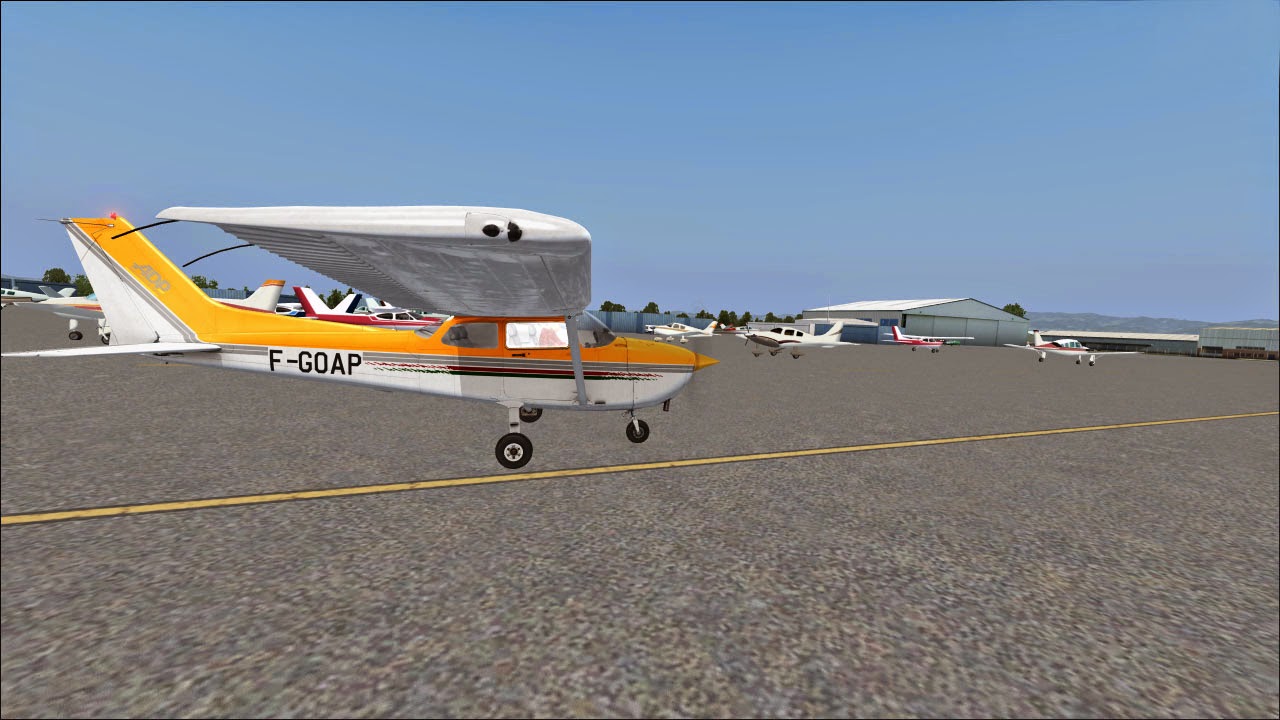
Many of my flights were not done with a pre-flight inspection though.  Yet for this flight, everything was checked outside the aircraft, from the hinges to the fuel.  Once completed the C172 checklist was pulled out.  Before long the engine was started and purring away.  After some brief fiddling with the GPS, I was slowly meandering down the taxi-way.  A large jet could be seen departing off of Runway 16.  A selection of GA aircraft and helicopters stood on display as if saluting C172 F-GOAP as it passed. 


Heading out

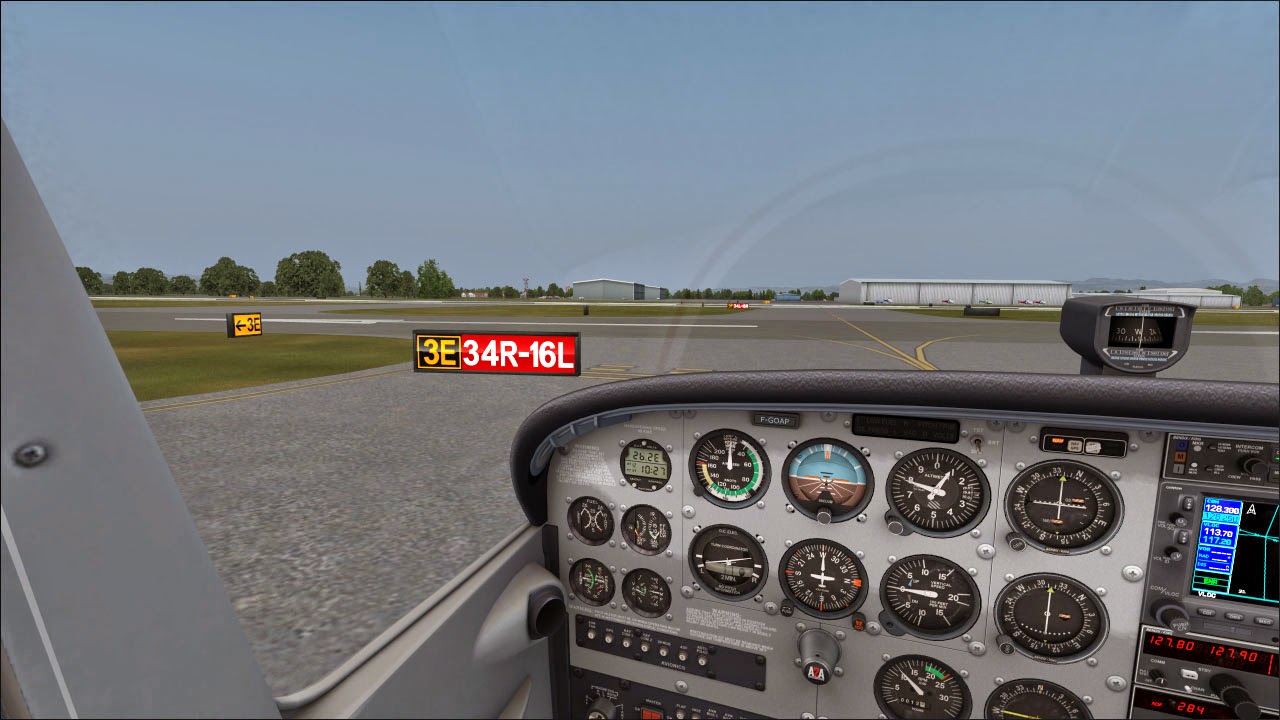
Upon reaching the edge of runway 16L, I started my before take-off checklist.  The engine power was increased to 1800 rpm for the mag check.  This called for switching between the magnetos, making sure there was no drop greater than 150 rpm between them. Unfortunately that is exactly what I found when switching to
Mag 1.  The decrease when switching to Mag 1 was greater than the allowed 150 rpm!  This was not in the plan for the day.  My guess was that extra fuel was clogging the engine and spark plugs.   This was surprising though as the mixture had been leaned while taxing.


Going through the before takeoff checklist.

           The throttle was pushed forward and the engine came to life.  This should clean out the old pipes I thought.   After a few moments the mag check procedure was done again.  There was still a large decrease in rpm when switching to Mag 1.   Ok, well, I’ll fix this... as the throttle was pushed forward again.   I’ll run it a good long time now!    But the mag check still failed?  To make matters worse, the quick check of A2A C172 notes section showed the engine temperature was getting high!! (Red, Red, Red!!!).

Mag check.


In a moment of stupidity the throttle lever was pushed forward again…  Get-there-it-is was calling me. After a good long time, the already over heated engine still failed the Mag check.  With defeat in my eyes, the A2A C172 was turned around and slowly driven back to the closest GA ramp.  Going to have to shut her off and pop the hood, I thought.  


This can't be good!

As the engine shut off, the fireworks began.  My guess is that the wind from prop was keeping the over-heated engine from popping.   Once those blades stopped turning the flames started churning. Game over, as smoke started to billow out of the front of my C172.

A2A C172, A little "To Real"!


Once the flames were out, the C172 was brought into the hanger.  There a very unhappy story unfolded.  My engine had bad plugs, a fuel leak, poor compression, low oil, and even loose flaps.   
This took a lot of mouse clicking, trying to rectify each problem.  If I had done this in the real world, the consequences would have been great!   But in the virtual world, all I lost was my pride.   My Accusimed C172 begged to be treated like the real thing, with love and care.   Unfortunately she had only received harsh treatment and reacted accordingly.

This is bad, real bad...

Luckily, a lot was gained from this experience.   The plane should have been checked in the hanger before pre-flight inspection.   I barely ever checked the plane in the hanger even after logging a lot of hours.  The engine should never have been run up so high for so long.  Research should have been done to find out what "real" pilots do when a mag check fails.  As a penalty the virtual flight for the day was cancelled.


Score:    The A2A C172   1   :  DeskPilot 0


Some might find the Accusim features of the A2A C172 an annoyance.  Heck, who wants to worry about engine temps, water in fuel lines, and loose hinges?  Can’t I just overheat my engine?  I have to admit that at times these features can be an annoyance.   Yet on the flip side, there is a pride that comes from prepping and flying the A2A C172 correctly.   There is an acknowledgement that you have to take care of your Cessna just like it was real.  Real pilots know to have their plane checked in the hanger on a regular basis.   While I am not a real pilot, I revel in the ability to learn about aviation and what “real” pilots experience.   To us desk pilots, the A2A C172 is “as real as it gets”, and in my case, that is a good thing!

Links:

A2A C172 with Accusim

Aerosoft Catalina Airport (Freeware)

FTX/Orbx Freeware Airports including Van Nuys Airport for FTX Global users.


Wednesday, April 30, 2014

The Airline Pilot Guy Podcast, a view into the cockpit.


APG podcast, playing on the old Ipad.

There is nothing more enjoyable than learning about the world of aviation straight from the horse’s mouth.  That is exactly what you get with each podcast from Captain Jeff (The Airline Pilot Guy).  The Captain is a real world pilot for a US legacy airline.   For obvious reasons, Captain Jeff does not disclose his employer. 
But we do know that he is currently employed as a captain and  he flies the Mad Dog MD82.    His motto is "The view from my side of the cockpit door".  


The typical Airline Pilot Guy podcast is about 2 hours long.  Each podcast is filled with many tidbits of information.   From Captain Jeff, we get a feel for what it really is like on the other side of the door.  We get the inside scope on the latest aviation news from accidents to changes in the airlines.  Captain Jeff regularly chats about everything from his latest flights, to his views on the airline industry, and aviation as a career.  He speaks many times about his concerns regarding the use of automation and safety in general.   Not to mention we also get a glimpse into his old days flying for the Air Force and flying the Tristar L1011.
       Captain Jeff's website

There are three requirements that I have for subscribing to a podcast.   The podcast must be produced on a regular basis, well produced, and well organized!  The Airline Pilot Guy’s podcast fulfills each of these requirements and then some.  Each week a new show is produced and ready to download and the sound quality is always good!  Captain Jeff rarely drones on about any topic.  His show is well organized with a news section, updates, and listener questions and feedback.   The fact that some shows are almost 2 hours long is an added bonus.  
While Captain Jeff is not a flight sim enthusiast, he fields  many questions from flight sim fans on his show.  Flight simulation has been discussed numerous times on his podcast and Captain Jeff has shown his admiration for it.  On a personal  level, flight simulation for the good Captain consist of being tested in a large metal box on what he might or might not, do wrong.   Simming, is not a fun part of his job, as he would probably say.     
                                                           Airline Pilot Guy on Youtube


As aviation enthusiast, we almost owe it to ourselves to subscribe to Captain Jeff’s podcast.   For aviation enthusiast such as myself and others, the PC flight simulator opens the door to the world of airline aviation.   We love to pretend we are captains of airliners like the MD82, 737 and 777.  But Captain Jeff’s podcast slams the door open with a lot of firsthand knowledge about what it is really like to be and airline pilot.   We also learn about all the real world responsibilities he has to shoulder.
Personally, I really enjoy when Captain Jeff discusses the recent aviation accidents and events.  His discussions about the Malaysian Air and the Air Asiana  accidents have been very insightful.   For example, he was the first person I know of to point out that a lot of the CNN reporting related to the disappearance of MH370 was full of a lot of BS.
Aviation related links on the APG website.

A good point that Captain Jeff made was that many of their so called “Aviation” experts had no real background in aviation at all!  Some of us flight simmers probably had more qualifications.
 I would bet that few of the PMDG T7 flyers know more about the 777 systems than some of those CNN jokers!

Captain Jeff has been quite vocal about the dangers of automation.   As he would say, "disconnecting the auto-pilot at 500 feet AGL before landing, is not flying" (Heavily paraphrased).
While he might laugh, (because I am not a real pilot), I have tried to follow Captain Jeff's advise in the simulator by disconnecting the autopilot in the Majestic Dash 8 in FSX, when ever possible.  My landings in the Q 400 might not be greasers, but many of them have been hand flown, greatly increasing my ability and confidence.

Hand flying the Q into EGBB

So I advise every aviation enthusiast to head over to the Airline Pilot Guy website at www.airlinepilotguy.com .   The website also includes various aviation related links relevant to each show!  Its worth mentioning that Captain Jeff has active communication with fans through Facebook.  You can also donate to Captain Jeff's Coffee Fund which helps pay for the cost of hosting the show and equipment.   Given the Captain's donation to the aviation community, that is money well spent!

The Airline Pilot Guy show can be downloaded from ITunes and Stitcher.    Episodes can also be found on Youtube.

Links:
www.airlinepilotguy.com
Airline Pilot Guy on Itunes
Airline Pilot Guy on Stitcher.com
Airline Pilot Guy on Youtube
Airline Pilot Guy on Facebook.